How to Choose Between a Tracked or Wheeled Dumper: A Buyer’s Decision Guide
Choosing between a tracked and wheeled dumper is an important equipment decision. The right machine can improve hauling efficiency and expand where you can work, while the wrong configuration can mean paying for capabilities you rarely use or struggling in conditions the machine isn’t designed to handle.
There’s no universal “better” option here. Tracked and wheeled dumpers are engineered to solve different problems. This guide breaks down the factors that actually matter when you’re weighing the two, so you can match the machine to the jobsite instead of the other way around.
Quick Decision Checklist
Use these questions to narrow down the right fit for your next project:
- Is soft, saturated or low-bearing ground the norm on this site, or the exception? If it’s the norm, a tracked dumper may be the better fit. If it’s occasional, a wheeled dumper may provide sufficient capability.
- How far and how often does material need to travel? Longer, frequent hauls on established surfaces can favor the speed and mobility of a wheeled dumper.
- Does the site have challenging off-road terrain? These conditions may favor a tracked machine’s traction and lower-ground-pressure design.
- How tight is the site layout? Consider turning radius, articulation and maneuverability alongside the terrain.
- What does total cost of ownership look like? Compare maintenance, component wear, utilization and productivity rather than focusing only on purchase price.
- Will the machine work across multiple sites? Consider the range of conditions you’ll encounter throughout the year and across your project pipeline.
- How will it fit with the rest of your fleet? Match dumper payload and capabilities to your loaders, excavators and overall material-handling process.
The Core Difference: How Each Machine Handles the Ground
The biggest difference between tracked and wheeled dumpers is how each machine transfers its weight and power to the ground.
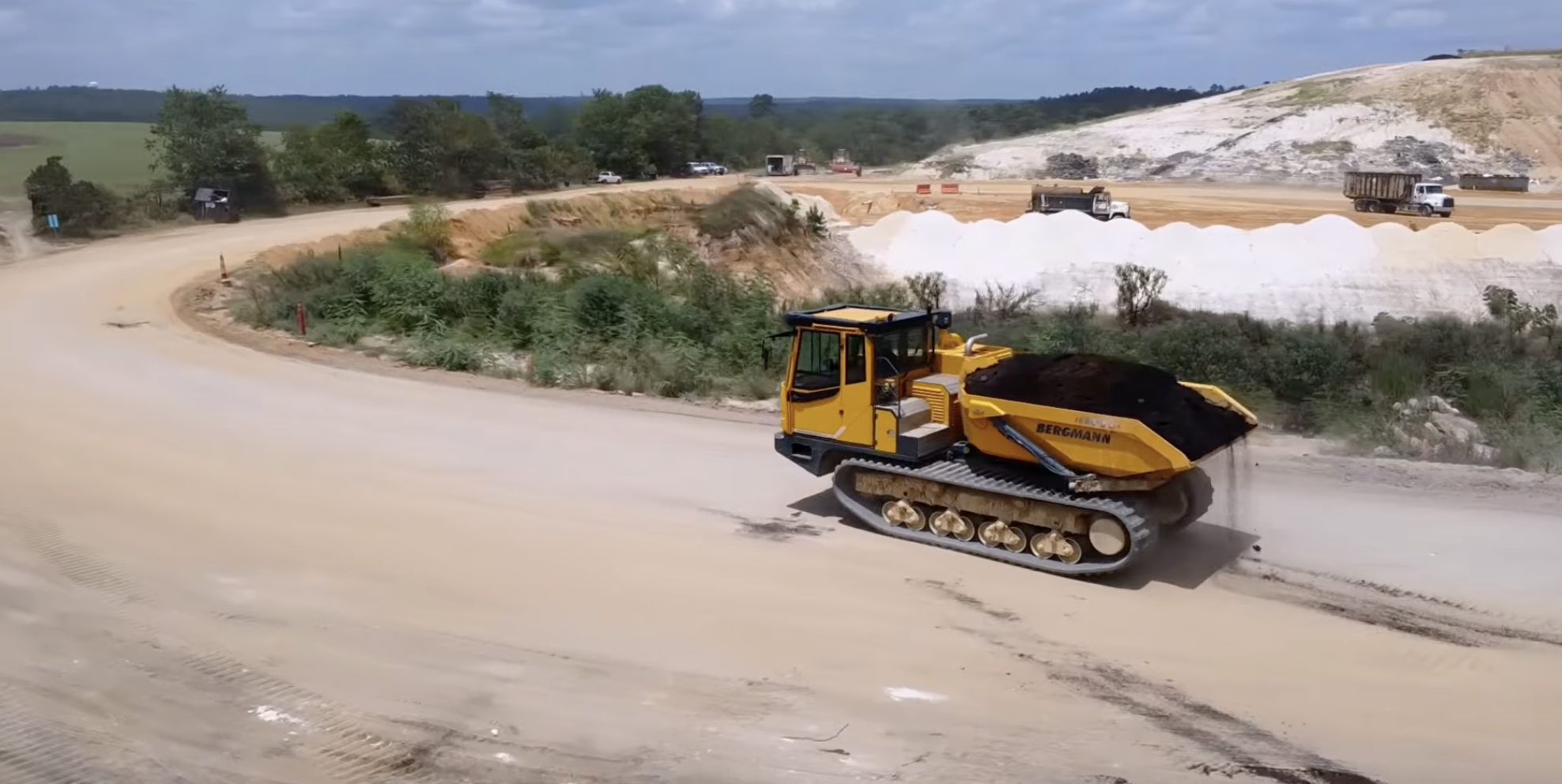
Tracked dumpers distribute their weight across a wide track footprint, reducing ground pressure and helping maintain traction on soft, unstable or uneven terrain. The Bergmann C912s, for example, uses 750 mm-wide rubber tracks and has a loaded ground pressure rating of 7.6 PSI, making it well suited for applications where ground conditions and access are major considerations.
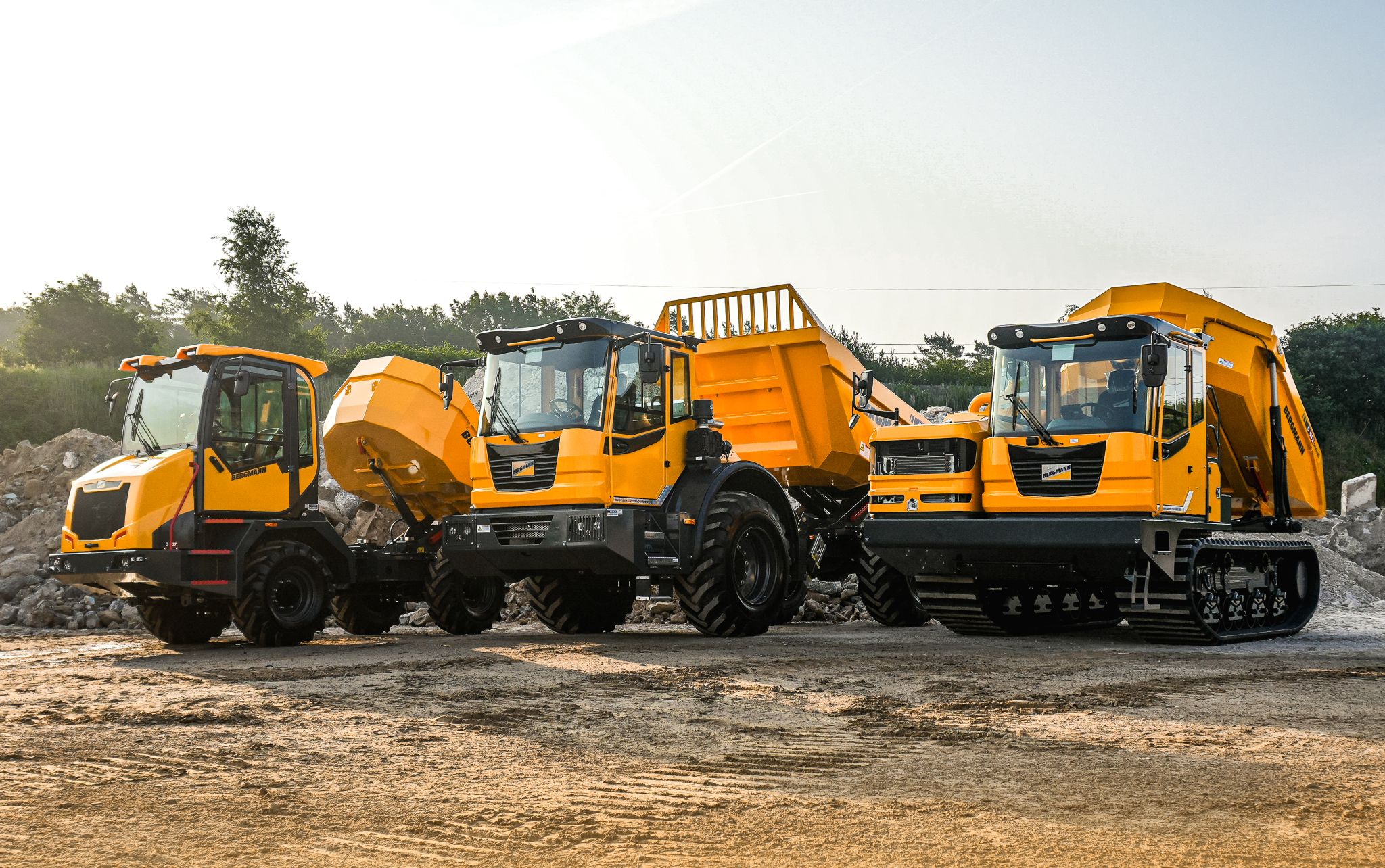
Wheeled dumpers rely on tires rather than tracks, which can provide advantages in travel speed, maneuverability and mobility across established surfaces. Their suitability for soft or uneven ground depends on factors including tire configuration, traction systems, power and suspension. Bergmann’s wheeled lineup spans multiple classes, from the C810s, designed for maneuverability on tighter sites, to the larger C815s, which combines higher horsepower and payload capacity with features designed to maintain traction in demanding conditions.
Neither configuration is universally better. The right choice depends on the ground conditions, travel distances, site layout and type of work the dumper will encounter.
Factor 1: Ground Pressure and Soil Bearing Capacity
If your site has consistently soft, saturated or low-bearing-capacity soil, ground pressure can become one of the most important considerations.
Wetlands, riverside work, freshly disturbed earth and sites that remain wet for extended periods can create conditions where a machine with a larger footprint has a clear advantage. Tracked dumpers distribute their weight across the tracks, reducing the pressure placed on each portion of the ground and helping the machine maintain mobility on difficult surfaces.
The Bergmann C912s, with its 7.6 PSI of loaded ground pressure, is designed for applications including soft and wet conditions, environmental work, pipeline construction, and steep-grade sites.
But soft ground isn’t always an automatic reason to choose tracks.
If ground pressure challenges are occasional or localized, a properly equipped wheeled dumper may still provide the traction and stability needed without requiring a tracked configuration. Tire size, flotation, differential design, axle suspension and power can all influence how a wheeled machine performs as conditions change. Bergmann’s wheeled dumpers incorporate features such as flotation tires, articulated steering, axle suspension and self-locking differentials, depending on the model.
The question to ask: Is soft ground the exception on this site, or the rule?
Factor 2: Jobsite Access and Travel Distance
Tracked and wheeled machines behave differently once you factor in how far material has to travel and what that path looks like.
Wheeled dumpers can be a strong choice when haul routes are relatively firm and established, when the dumper needs to travel between multiple work zones or when faster travel can improve cycle times. For example, the compact Bergmann C810s reaches around 19 mph, while the larger C815s reaches 25 mph, compared with 10 mph for the C912s.
That difference can matter when a machine spends a significant portion of its day traveling between load and dump points.
Tracked dumpers are typically designed to prioritize traction and mobility across challenging terrain rather than maximum travel speed. The C912s, for example, has a maximum speed of 10 mph, but its tracked undercarriage and low ground pressure allow it to access terrain that may be difficult or impossible for wheeled equipment.
The key is determining which machine’s strengths will have the greatest impact on your overall haul cycle.
The question to ask: Does this site have established, relatively stable haul routes, or is the dumper expected to go where no road exists yet?
Factor 3: Payload, Productivity, and Site Layout
Payload is only part of the productivity equation. What matters is how efficiently that payload moves through the entire haul cycle.
On a compact site with frequent turns, a wheeled dumper’s maneuverability and travel speed can help keep cycles moving. Compact models like the Bergmann C810s can be advantageous on tighter, congested sites, with an articulated joint and front axle suspension that support maneuverability. Wheeled dumpers as a category can be particularly useful when material needs to move frequently between multiple areas of a relatively established site.
On a site where terrain itself is the obstacle, a tracked dumper’s traction and stability may matter more than maximum travel speed. If a machine can maintain forward progress across soft, uneven or challenging terrain without requiring frequent route changes, that capability can have a significant effect on productivity.
The goal is to evaluate the entire material-hauling cycle:
- Loading
- Traveling
- Maneuvering
- Dumping
- Returning for the next load
A machine that performs efficiently across the entire cycle can move more material over the course of a workday, even if it isn’t the fastest machine in every individual part of the process.
The question to ask: Which machine will complete the most productive hauling cycles under your actual site conditions?
Factor 4: Maintenance, Operating Cost, and Total Cost of Ownership
Tracks can add valuable capability, but that capability comes with additional considerations for ownership and maintenance.
Tracked machines require attention to their undercarriage, including tracks and associated components. Wheeled machines require regular attention to tires and other wheel-end components. The cost and frequency of maintenance will depend heavily on the machine, application, ground conditions and utilization.
Travel patterns also matter. A tracked machine may make sense when its ability to access difficult terrain directly contributes to keeping a project moving. But if the majority of a machine’s work takes place on firm surfaces where that capability isn’t needed, a wheeled dumper may offer a more practical fit.
The goal isn’t to choose the machine with the lowest maintenance cost. It’s to understand what you’re paying for and whether those capabilities contribute to productivity on the job sites where the machine will actually work.
The question to ask: Are you investing in capabilities you’ll use regularly, or capabilities you may rarely need?
Factor 5: Versatility Across Multiple Sites
A machine’s value doesn’t end when one project does.
If your fleet moves between jobsites with different ground conditions, the right choice may depend less on your next project than on the range of work you expect to take on over the life of the machine.
Consider how frequently you’ll encounter soft ground, challenging grades, established haul roads, tight access points and other conditions that could influence machine selection.
A wheeled dumper with strong traction capabilities, articulated steering, axle suspension and a self-locking differential, for instance, may be able to handle a wide range of applications while providing the travel speed and mobility that make sense for established jobsites. That range spans classes, too: a compact model like the C810s can maneuver tight, congested sites where a larger unit wouldn’t fit, while a larger model like the C815s can move heavier payloads at higher speeds on more open sites.
If soft, unstable or challenging terrain is a recurring condition across your project pipeline, a tracked dumper may provide capabilities that can be used repeatedly rather than occasionally. The Bergmann C912s is designed for demanding applications including pipeline, environmental, utility and sewer construction, trenching, challenging grades and soft or wet conditions.
The question to ask: What conditions will this machine encounter across your entire project pipeline, not just on your next job?
Factor 6: Consider Your Entire Fleet
A dumper rarely works alone. It is typically part of a larger material-handling system that includes excavators, loaders, pavers and other equipment.
That makes fleet compatibility another important consideration.
Think about:
- Whether your existing excavator or loader can efficiently fill the dumper
- How the dumper’s payload fits with your loading equipment
- Whether the machine can access the same areas as the rest of your fleet
- How easily the dumper can move between different work zones
- Whether the configuration complements the way your crews already work
A machine that fits naturally into your existing workflow can provide more value than one selected solely on individual specifications.
The question to ask: How well does this dumper fit into the equipment and workflow you already have?
Tracked or Wheeled: Which Is Right for You?
Tracked and wheeled dumpers solve overlapping but distinct problems.
Tracks can provide advantages when access, ground pressure and traction are the primary concerns. The Bergmann C912s, for example, combines a 750 mm tracked undercarriage with 7.6 PSI loaded ground pressure and a hydrostatic drive designed to maintain traction across demanding terrain.
Wheels can provide advantages when travel speed, maneuverability and mobility across established surfaces are higher priorities. Bergmann’s wheeled lineup spans compact and higher-capacity machines, giving contractors options for different site layouts, payload requirements and travel demands.
And the distinction isn’t always as simple as “tracks for mud, wheels for everything else.”
Wheeled dumpers, when properly equipped, can hold their own in demanding conditions that might otherwise seem to call for tracks. The Bergmann C815s offers a real-world example: On a muddy jobsite where other equipment struggled to maintain traction, the wheeled dumper continued moving material through saturated conditions. Its combination of power, radial tires, axle design and traction features helped it keep working as conditions deteriorated.
For a closer look at tracked equipment, learn more about the Bergmann C912s and how tracked dumpers perform in demanding conditions.
Match the Machine to the Jobsite
The right dumper isn’t necessarily the one with the most capability. It’s the one with the right capabilities for the work you actually do.
Tracks can open access to terrain that may challenge wheeled equipment, while wheels can provide speed and mobility that make sense for longer hauls and established travel routes. Ground conditions, travel distance, site layout, payload, maintenance considerations, fleet compatibility, and utilization all play a role in determining which configuration makes the most sense.
Before making a purchase, look at the conditions your equipment encounters most often, not just the worst conditions it might encounter once in a while.
The right call depends on how often your site’s ground conditions push past what a wheeled machine can handle, not on which category sounds more rugged on paper.
Explore Bergmann dumpers to compare configurations and find the right fit for your operation.