
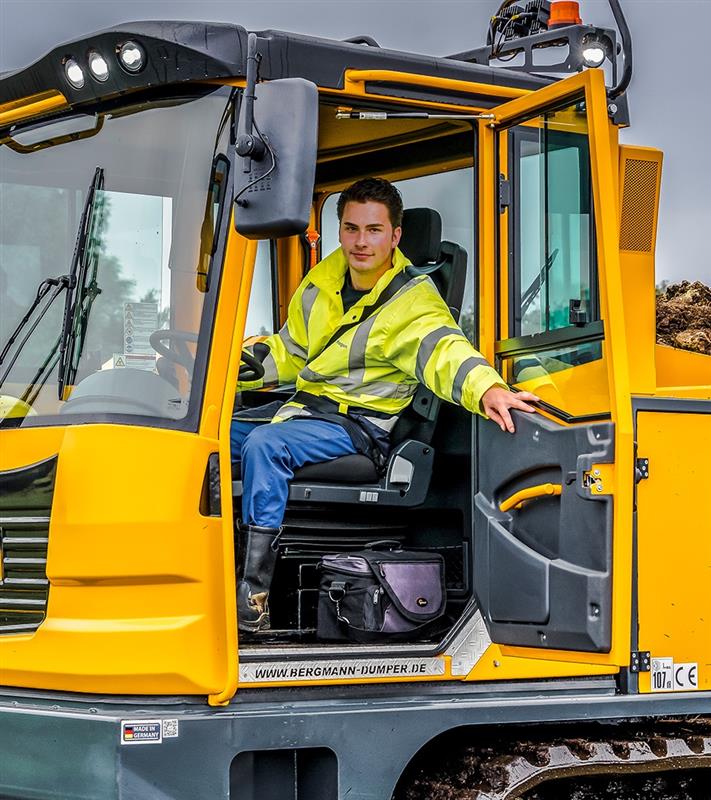
Why the Bergmann Comfort Cab Sets the Standard for Operator Comfort
When you’re on the jobsite, comfort is a productivity and safety tool. Operators spend long hours in the cab, and every detail, from seat suspension to control layout, can make a difference in fatigue, focus, and efficiency.
When operators talk about comfort, they are typically describing how the machine feels over eight, ten, or twelve hours of operation, not just how it looks on a spec sheet. Cab layout, ride quality, climate control, and ease of operation all play a role. While all manufacturers aim to meet safety and performance standards, different design approaches can create noticeably different operator experiences.
This overview compares how the Bergmann Comfort Cab, Hydrema, Terramac, and Morooka differ across key comfort, and usability-related areas, based on operator feedback and observed machine characteristics.
Cab Size & Space
Bergmann: Bergmann cabs offer a larger interior footprint, with more legroom, headroom, and overall usable space. Operators often notice the additional room when rotating in the seat or spending long periods in the cab. The available space also allows operators to keep personal items such as lunchboxes and extra gear inside the cab without interfering with controls or seating position.
Hydrema: Hydrema cabs are more compact in comparison but remain functional and well laid out. The design prioritizes visibility, with extensive glass surfaces that contribute to an open feel.
Terramac & Morooka: Terramac and Morooka tracked units typically have narrower cab designs. Operators are positioned closer to the cab glass, and interior space for personal items is more limited.
Entry & Exit Design
Bergmann: Bergmann cab entry and exit points are designed to provide a comfortable climb for both rubber-tired and tracked machines. Operators often describe entry and exit as straightforward and easy to navigate. This is particularly important for safety when operators are climbing in and out multiple times per shift, especially in challenging weather conditions.
Hydrema 912G: Hydrema’s cab is a spacious, suspended cab with a one-step entry and automatic entry lighting to improve safety in low-light conditions.
Terramac RT7R: The RT7R features a wide access door for easy entry and exit, designed to reduce strain for operators.
Morooka MST 2200VD: The MST 2200VD includes a rear escape window for emergency exit if the cab door cannot be opened. Operators are instructed to remove the seal and push the window outward, and to remove the seat headrest if needed to prevent obstruction. Under normal conditions, the rear window should remain in place and clear of equipment.
Seat Design & Ride Experience
| Brand / Model | Seat Type | Suspension | Special Features / Notes | Ride Considerations |
|---|---|---|---|---|
| Bergmann (all models) | Air-ride operator seat | Integrated into machine suspension | Rebound‑dampening helps reduce secondary jarring; consistent setup on rubber‑tired and tracked dumper | Smooth handling on rough terrain; forgiving for cab‑forward designs |
| Hydrema 912G (optional) | Air-ride operator seat | Electric suspension with two independent suspension cylinders | Front suspension noticeable when starting the machine | Operators may feel front‑end lift; ride influenced by cab‑forward design |
| Terramac RT9 | Air-ride operator seat | Fixed, rigid suspension with planetary reduction at hubs | Comfort‑focused adjustments, rigid axle prioritizes durability and torque transfer | Terrain conditions affect joystick input and travel smoothness |
| Morooka MST 2200VD | Suspension operator seat | Front idler roller with shock absorption | Front idler roller supports and guides the track to maintain proper alignment while absorbing some impact and vibration. | Joystick‑based travel; terrain may affect smoothness and speed consistency |
Bergmann seats are designed to reduce secondary jarring motion, improving comfort during long shifts. Hydrema’s air-ride seat is optional and paired with an electric suspension. Terramac combines a fully adjustable air-ride seat with a rigid axle system focused on durability. Morooka pairs a suspension seat with a shock-absorbing front idler roller to support smoother travel on uneven terrain.
Control Layout & Operation
Bergmann: Controls and function buttons are grouped within arm’s reach and arranged in a consistent, clearly labeled layout. The 4-wheel drive control is positioned directly behind the joystick, and the panel with switches (lights, rear work lights, etc.) is angled intuitively toward the operator. Bergmann machines also include an auto-return dump body function, allowing the bed to return to its resting position with a single control input, reducing the need for manual adjustment to align the bed.
Hydrema: Hydrema features short-handle fingertip controls, which are responsive and precise. Controls are mounted on a post to the operator’s right, grouping switches vertically and requiring operators to extend their reach toward the post for certain functions.
Terramac & Morooka: Joystick controls on tracked units are positioned forward. Operators may need to lean forward to maintain travel input, particularly during longer operating periods. In some configurations, joystick placement can require operators to shift their seated posture to maintain consistent input.
Front Suspension Systems
Bergmann C815s: Equipped with a leaf-spring and hydraulic strut on the front axle.
Hydrema 912HM: Uses an electric suspension with two independent suspension cylinders
on the front axle.
Both Bergmann and Hydrema incorporate front suspension systems designed to address ride characteristics common to cab-forward truck designs.
Climate Control & Cab Environment
Bergmann: Cab climate control is supported by vent placement designed to circulate air efficiently throughout the cab. Heated windshields and heated mirrors are standard features, along with electrically adjustable mirrors. The cab design limits excessive glass surface area, which can help stabilize internal temperatures in both extreme heat and cold. Heated seats are also available.
Hydrema: Hydrema cabs use a larger amount of glass to enhance visibility. This design can influence cab temperature, particularly in warmer conditions where increased solar exposure may require additional cooling time. Air vents are positioned lower in the cab.
Terramac & Morooka: Air vents are positioned lower in the cab. Combined with smaller interior space, this can affect airflow distribution throughout the cab.
Steering & Speed Control
Bergmann (C912s): The C912s features a steering wheel rather than joystick control, which many operators find more comfortable for extended operation. The machine includes V-Max control and an RPM dial, allowing operators to set a maximum travel speed. This enables consistent speed management across varying terrain without constant adjustment of the accelerator. For example, on hard-packed surfaces where the ride becomes rough, operators can turn down the V-Max to set a comfortable maximum speed while still pressing the accelerator fully. This reduces the need to find a ‘sweet spot’ with foot pressure and minimizes operator fatigue
Bergmann C815s & Other Models: Equipped with a steering wheel rather than joystick travel control. The Bergmann C810s and C807s also include a swivel seat, allowing operators to rotate for multi-directional operation, which improves visibility and ease of control in confined or complex jobsite conditions.
Terramac & Morooka: Joystick-controlled travel requires continuous operator input. Changes in terrain can influence speed consistency due to joystick movement. Every bump can move the operator’s arms, shifting the joysticks and causing the machine to respond with variations in speed.
Visibility & Camera Systems
Bergmann: Bergmann machines use side mirrors (no traditional rear-view mirror) and include a rear-view camera monitor as standard equipment, positioned directly in the operator’s line of sight. A 360-degree camera system is available as an option for applications requiring enhanced visibility, particularly popular on the C815s Mat Hauler for comprehensive visibility around the machine.
Hydrema: Rear-view cameras are available as optional equipment at additional cost.
Terramac & Morooka: Visibility features vary by model and configuration.
The Connection Between Comfort and Performance
An operator who feels safe and supported by comprehensive visibility systems and standard safety features works with greater confidence. Comfort translates to personal satisfaction, which is often associated with productivity across applications. Operators who aren’t fighting fatigue, awkward controls, or temperature extremes can maintain focus on the task throughout the shift, resulting in more consistent performance and fewer errors.
Each manufacturer approaches cab design differently, balancing visibility, space, control style, and ride characteristics. Bergmann, Hydrema, Terramac, and Morooka all offer solutions suited to specific applications and operator preferences. Understanding these differences helps equipment buyers and operators choose the machine that best aligns with their jobsite needs and operating conditions.
More questions? We’re here to help!