
Spring Thaw Is Coming: Is Your Equipment Ready for Soft Ground Conditions?
When winter finally breaks, and frozen ground begins to thaw, your jobsite can change overnight. What felt stable in January may quickly become soft, saturated, and full of hidden hazards by March.
The question isn't how much your machine can carry, but how much impact it will leave behind. That's where ground pressure matters most.
But what exactly is ground pressure, and how low does it really need to be to protect your soil and turf?
What Is Ground Pressure?
Ground pressure is the amount of weight a machine applies to the surface beneath it, typically measured in pounds per square inch (PSI).
The concept is simple: More weight concentrated in a smaller contact area = more pressure into the ground.
A helpful analogy:
- A person in sneakers spreads their weight.
- A person in high heels concentrates it.
Same person, a very different ground impact. For equipment, the same principle applies.
Why Ground Pressure Matters in Spring
During the spring thaw, soil structure is weaker. Moisture levels are higher. Turf and subgrade are more vulnerable to:
- Rutting
- Soil compaction
- Surface damage
- Costly remediation
Even a few extra PSI can be the difference between moving material efficiently and shutting down to fix damage.
What Is the Ground Pressure of Bergmann Dumpers?
Below are loaded ground pressure ratings (PSI) for Bergmann models:
- C815s Swivel: 14.2 PSI
- C815s Rear Dump: 10.9 PSI
- C815s 3-Way: 12.5 PSI
- C805s: 6.0 PSI
- C807s: 9.7 PSI
- C810s: 10.2 PSI
- C912s: 7.6 PSI
These numbers represent ground pressure under load, which is what truly matters on the jobsite.
While empty PSI can be calculated, manufacturers focus on loaded ground pressure because that reflects real working conditions, when machines are actually moving material.
Does Payload Affect Ground Pressure?
In simple terms: more weight equals more pressure.
Ground pressure is driven by total weight: the heavier the machine plus payload, the more pressure it puts on the ground, no matter the type of material.
That's why manufacturers focus on weight distribution and tire design, rather than simply reducing payload.
What Reduces Ground Pressure?
The biggest factor? Tire size.
The more surface area in contact with the ground, the more weight is distributed, and the lower the PSI.
A great example is the comparison between two 815 models:
- C815s Swivel (650mm tires): 14.2 PSI loaded
- C815s Rear Dump (750mm tires): 10.9 PSI loaded
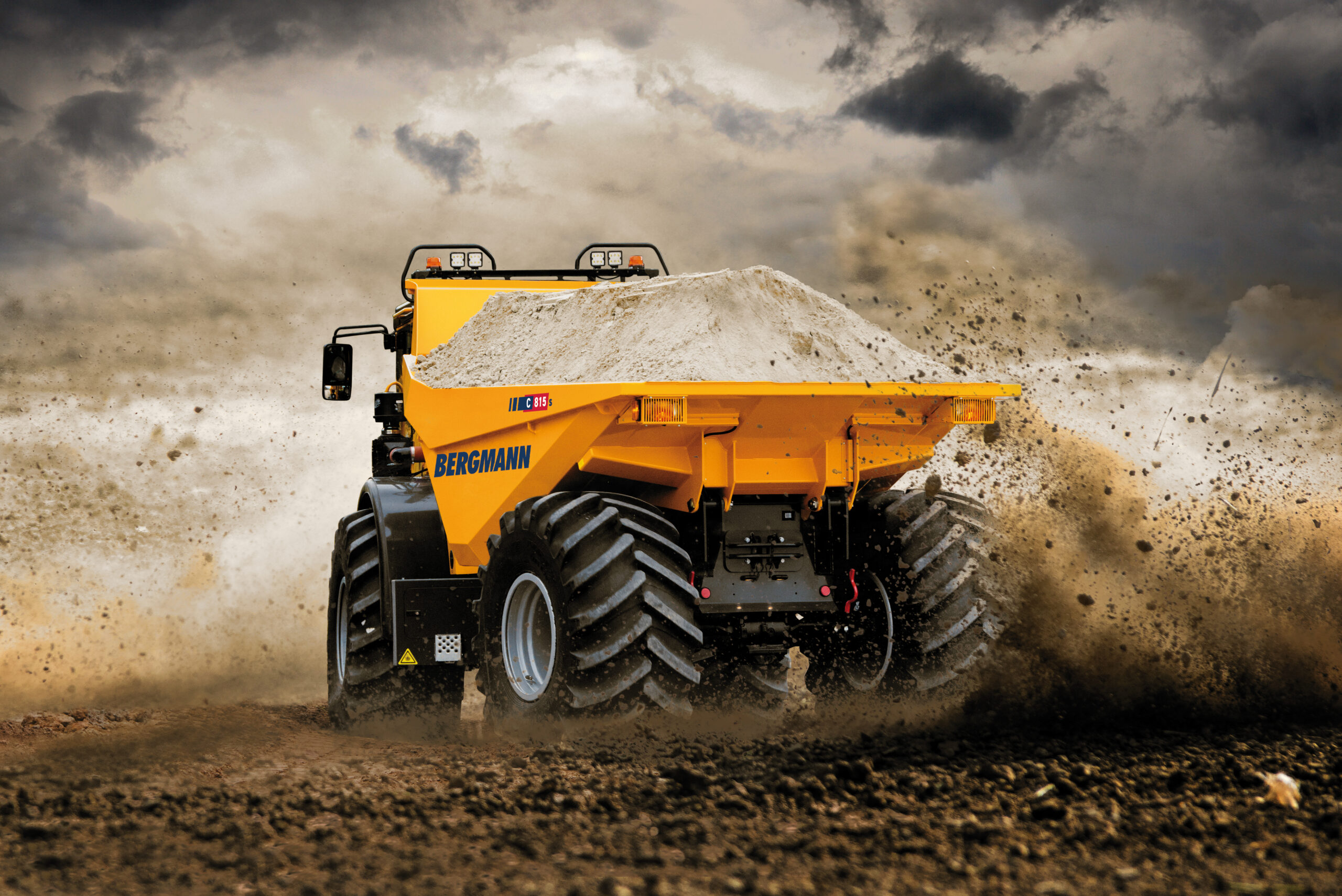
Both trucks carry the same load, but the C815s Rear Dump (750mm tires) has a lower ground pressure than the C815s Swivel (650mm tires): 10.9 PSI vs. 14.2 PSI. That extra 100mm of tire width spreads the weight over a larger area, reducing PSI and protecting the ground.
This principle applies across Bergmann's lineup, whether rubber tires or tracked units: more contact area = less ground impact.
Rubber Tires vs. Tracks: A Different Approach to Low Ground Pressure
Many contractors assume tracks are the only solution for soft ground, but Bergmann takes a different approach.
While tracks can achieve very low PSI, Bergmann's rubber tire units are designed to spread weight efficiently while keeping operators productive.
Rubber tire dumpers:
- Travel faster than track units
- Often carry larger payloads
- They are typically preferred by operators
- Deliver higher productivity on most jobsites
In many applications, Bergmann rubber tire dumpers can do the same work as track units, but faster and more efficiently, while still maintaining low ground pressure.
The Bigger Question This Spring
When spring soil softens, the question isn't just: "How much can this machine carry?"
It's: "How much impact will it leave behind, and how quickly can I get the job done without creating costly damage?"
Understanding ground pressure and how tire size, contact area, and total machine weight influence it can help contractors avoid costly damage and keep projects moving through the spring thaw.
In many spring conditions, that balance between productivity and reduced ground impact matters more than simply achieving the absolute lowest PSI possible.
Learn which Bergmann dumper is right for your spring projects.